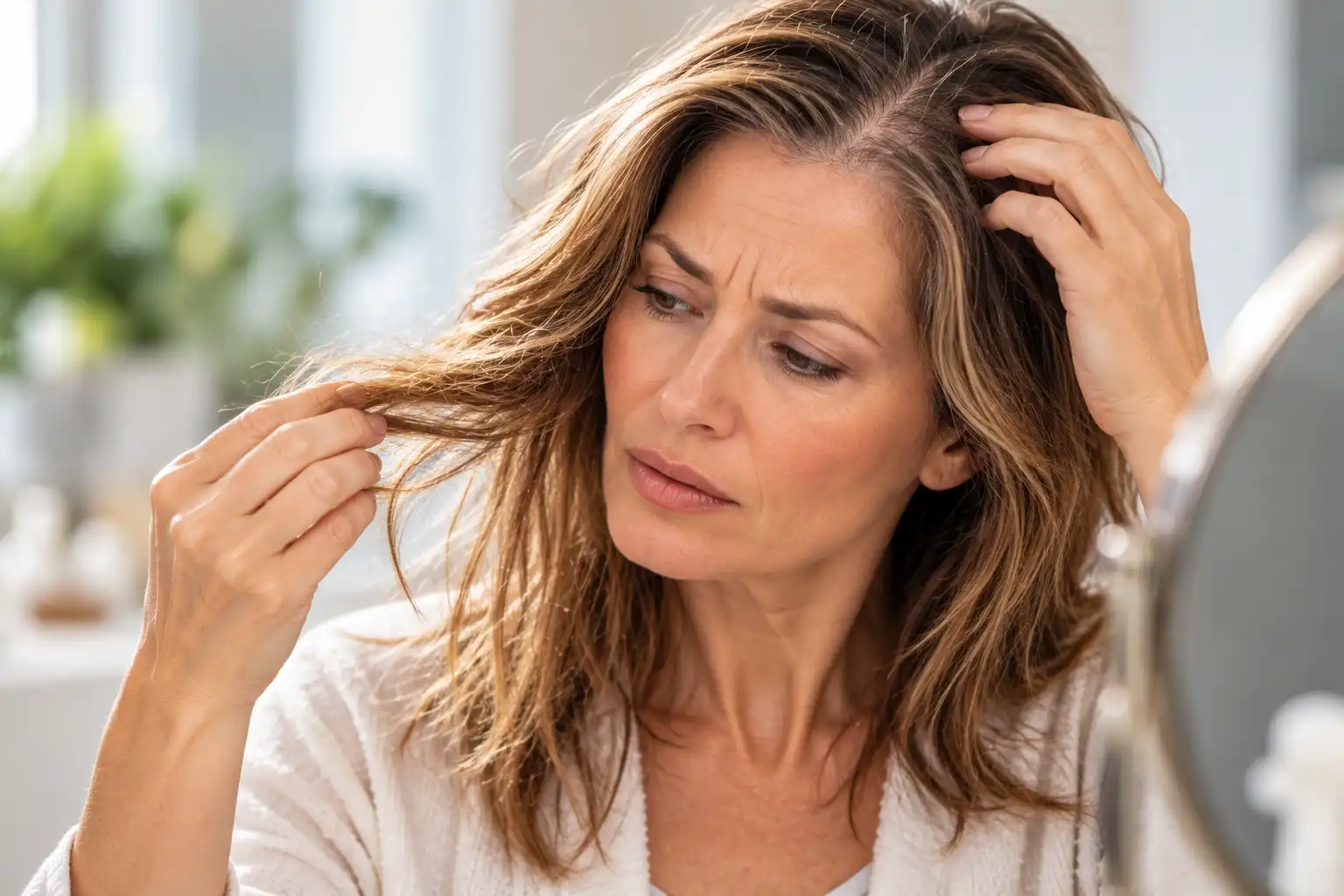
The 15-second version
- Hair changes are common around menopause. In one study of 178 postmenopausal women, 52.2% had female pattern hair loss.1
- Falling estrogen shortens the growth phase of the hair cycle and leaves androgens, the hormones that shrink follicles, with less to balance them.2
- Shedding, a wider part, finer strands and drier hair are the usual signs.2
- In Canadian consensus recommendations, 5% topical minoxidil is a first-line option for pre- and post-menopausal women, and treatment works best when it starts early.3,4
- A short list of questions and a few weeks of photos make the visit with your doctor more useful.
What happens to hair around menopause
Menopause happens at an average age of 51, and the transition can begin up to 10 years earlier.2 Hair follicles respond to those hormone changes. Researchers describe changes in hair density, in the width of each strand and in texture, along with a higher rate of female pattern hair loss and shedding after menopause.2
These changes are common. The Canadian Dermatology Association reports that about 40% of women have some thinning hair by age 50.5
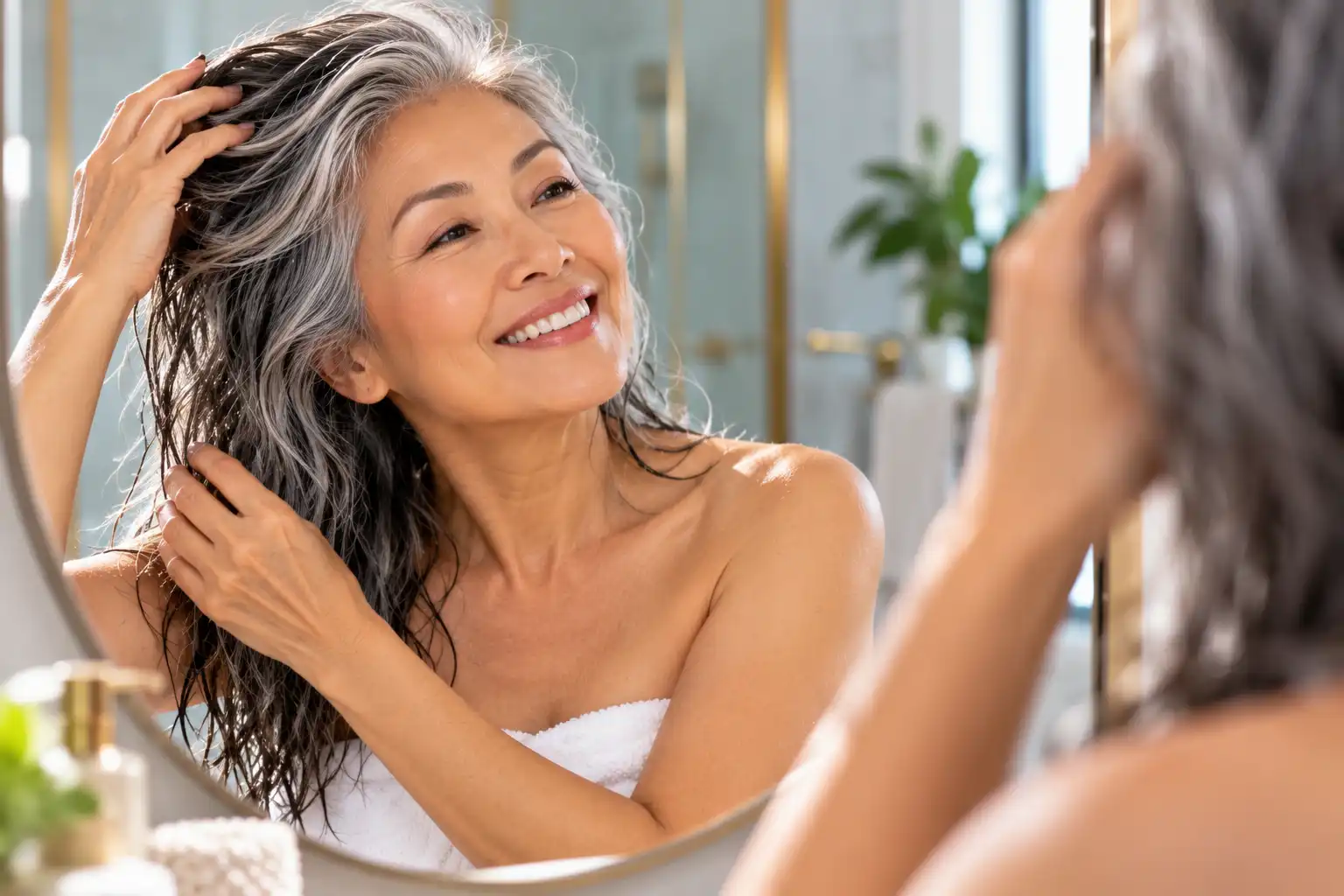
Every hair follows a cycle of growth, a short transition, rest and shedding. In postmenopausal women, a smaller share of hairs are in the growth phase, and the difference is greater at the front of the scalp than at the back.2
Why falling estrogen changes hair
Hair follicles carry estrogen receptors, and estrogen appears to protect hair growth.2 The evidence is indirect but consistent. Female pattern hair loss becomes more common after menopause, the growth phase lengthens during pregnancy when estrogen is high, and some women taking tamoxifen or aromatase inhibitors for breast cancer report hair loss.6
Androgens matter too. Estrogen stimulates the liver to make sex hormone binding globulin (SHBG), which carries androgens in the blood. When estrogen falls, SHBG falls, and more androgen is free to act on the follicle.2 Androgen levels also start to decline several years before menopause, so the balance between the two hormones shifts gradually.6
In women who are genetically susceptible, androgens gradually shrink follicles, so each one grows a shorter, finer hair. This process, called miniaturization, shortens the growth phase and produces the pattern seen in female pattern hair loss.7
How common is it? Estimates vary with the population studied and how hair loss is measured. One review gives 14% to 28% for white women in their 50s.6 A study of 178 healthy postmenopausal women aged 50 to 65 found 52.2%, and the share rose with age, time since menopause and body mass index.1
What the changes look like
These are the patterns doctors see most often in midlife, and what each one usually points to. Severity varies widely from one woman to the next, and many notice little change.9
| Pattern | What you may notice | What it usually points to |
|---|---|---|
| Wider part or thinner crown | The scalp shows more along the part or on top of the head, while the hairline stays in place | Female pattern hair loss59 |
| More hair on the brush and in the drain | A clear increase in shedding all over, over weeks to months | Telogen effluvium, a temporary wave of shedding2 |
| Finer strands and less volume | A thinner ponytail and hair that looks less full | Smaller follicles and changes in hair density and strand width2 |
| Drier, more brittle hair | Less shine and more breakage | Hormone-related changes in the scalp’s natural oil8 |
| A change in texture | Hair that is straighter, curlier or frizzier than before | Hormone-related changes in the hair shaft2 |
| A receding frontal hairline with thinning eyebrows | The hairline moves back, sometimes with redness or scaling | Frontal fibrosing alopecia, which needs a dermatologist10 |
Other midlife causes that overlap
Menopause is rarely the only thing going on at this age, so doctors look at the whole picture before settling on a cause. Blood tests can check for common contributors. A typical workup includes thyroid function, a complete blood count and iron stores, and sometimes sex hormones.1112 These tests screen for other conditions that can cause or add to generalized hair loss.12
Low iron and other nutrient shortfalls have been linked to shedding, and the fix is to correct a confirmed deficiency.14
Telogen effluvium also turns up more often after menopause.2 It usually starts two to three months after a trigger such as illness, surgery, major stress or a sudden change in diet, and hair typically recovers within about six months once the trigger has passed.13 It can occur together with female pattern hair loss, which is one reason a proper diagnosis helps.
What the research says about treatments
Hair loss in midlife is well studied, and treatment can prevent it from worsening and help many women regrow hair. Treatment works best when it starts at the first sign of hair loss.4
Topical minoxidil
Topical minoxidil is the best-studied option. A Cochrane review found minoxidil solution effective for female pattern hair loss,11 European evidence-based guidelines recommend it for women,15 and a 2025 Canadian consensus recommends 5% topical minoxidil as a first-line option for both pre- and post-menopausal women.3 In Canada it is sold without a prescription. Treatment needs to continue for at least six months before the benefits can be assessed, and long-term use is usually needed to sustain them.11
Prescription options
For some women, doctors also consider prescription medicines. The Canadian Dermatology Association lists finasteride, dutasteride and spironolactone as options for female pattern hair loss.5 A 2025 review in the Journal of the American Academy of Dermatology found that oral antiandrogens show some efficacy in women, and that age, signs of excess androgens and the need for contraception help guide the choice.7 Contraception matters because you can still become pregnant during perimenopause.
Hormone therapy
Hormone therapy is prescribed for menopause symptoms such as hot flashes. For hair, a 2025 review concluded that estrogen therapy, topical or oral, has shown limited efficacy compared with standard treatments and is not considered standard care for hair loss.2 If you are weighing hormone therapy for other reasons, mention your hair at the same visit so your doctor sees the full picture.
Other options
Low-level laser therapy, platelet-rich plasma and hair transplant are other options a dermatologist can discuss.2
Everyday hair and scalp care in midlife
Daily habits protect the hair you have and help it look its best.
- Go easy on tension. Tight ponytails, braids and extensions pull on follicles and can cause traction alopecia, which is reversible when caught early.17
- Look after a drier scalp. Hormonal changes affect the scalp’s natural oil, so many women find their scalp and hair feel drier after menopause.8 A gentle cleanser and a conditioner on the lengths are easy places to start.
- Get nutrients from food first. If you suspect a deficiency, ask for a blood test before taking biotin, iron or zinc. Supplements help only when you are deficient, and too much iron can be harmful.16
- Treat stress and sleep as hair care. Major stress can trigger shedding months later.13
If you would like a simple routine, HUSSSH Hair Therapy Shampoo and Conditioner are sulphate-free cosmetics made with plant oils and extracts for thicker, fuller-looking hair. None of the research in this article tested them.

Questions to bring to your doctor
A short list makes a short appointment more useful. Pick the questions that fit you.
- Is this female pattern hair loss, shedding from another cause, or both?
- Should we check my thyroid function, iron levels and blood count?1112
- Could a medication, a recent illness or a major stress be contributing?
- Do my hair changes fit with perimenopause or menopause, and does that affect other treatments I am considering, such as hormone therapy?2
- Is minoxidil a good starting point for me, and which strength and form should I use?3
- Are any prescription options suitable for me, given my contraception, pregnancy plans and other medicines?7
- How long should I use a treatment before we judge it, and what will we look for?11
- Which supplements, if any, make sense for me?16
- Should I see a dermatologist, and does anything on my scalp or hairline need a closer look?10
What to bring and track
- Photos of your part and hairline, taken in the same light once a month for two to three months
- When you first noticed changes, and whether they came on suddenly or slowly
- Any family history of hair loss, on either side
- A list of your medications and supplements
- Other changes you have noticed, such as changes in your periods, hot flashes or sleep
- Your current hair care routine and styling habits
When to see a doctor sooner
Most midlife hair changes develop gradually. Book an appointment promptly if you notice:
- Sudden, heavy shedding or hair coming out in clumps
- Round or patchy bald spots
- A receding frontal hairline, especially with thinning eyebrows
- Itching, burning, pain, redness or scaling on the scalp
- Shiny or scarred-looking skin where hair used to be
- Thinning together with fatigue or unexplained weight changes
Frontal fibrosing alopecia is a scarring condition, and hair does not regrow unless treatment starts early. Eyebrow thinning often comes before the scalp changes, so an early visit is worth it.10
Frequently asked questions about menopause and hair
Reviews find limited efficacy for estrogen therapy as a hair loss treatment compared with standard options, and it is not considered standard care for hair loss.2 Hormone therapy is usually chosen for other menopause symptoms, so mention your hair when you discuss it.
Hormonal changes after menopause affect sebum production, the scalp's natural oil.8 A gentle cleanser and a conditioner on the lengths can help hair feel softer.
Dermatologists recommend taking biotin, iron or zinc only when a blood test shows a deficiency.16 Ask your doctor which tests make sense for you.
References
- Chaikittisilpa S, Rattanasirisin N, Panchaprateep R, et al. Prevalence of female pattern hair loss in postmenopausal women: a cross-sectional study. Menopause. 2022;29(4):415-420. PubMed ↩
- Gupta AK, Economopoulos V, Mann A, Wang T, Mirmirani P. Menopause and hair loss in women: exploring the hormonal transition. Maturitas. 2025;198:108378. doi:10.1016/j.maturitas.2025.108378 ↩
- Landells I, Chow E, Gupta AK, et al. A Canadian consensus on androgenetic alopecia: approach and management. J Cutan Med Surg. 2025. doi:10.1177/12034754251368849 ↩
- American Academy of Dermatology Association. Thinning hair and hair loss: could it be female pattern hair loss? aad.org ↩
- Canadian Dermatology Association. Alopecia. dermatology.ca ↩
- Carmina E, Azziz R, Bergfeld W, et al. Female pattern hair loss and androgen excess: a report from the Multidisciplinary Androgen Excess and PCOS Committee. J Clin Endocrinol Metab. 2019;104(7):2875-2891. OUP ↩
- Ong MM, Avram M, McMichael A, Tosti A, Lipner SR. Antiandrogen therapy for the treatment of female pattern hair loss: a clinical review of current and emerging therapies. J Am Acad Dermatol. 2025;93(3):749-760. doi:10.1016/j.jaad.2025.04.074 ↩
- Piérard-Franchimont C, Piérard GE. Alterations in hair follicle dynamics in women. BioMed Res Int. 2013;2013:957432. doi:10.1155/2013/957432 ↩
- Rinaldi F, Trink A, Mondadori G, Giuliani G, Pinto D. The menopausal transition: is the hair follicle “going through menopause”? Biomedicines. 2023;11(11):3041. doi:10.3390/biomedicines11113041 ↩
- DermNet NZ. Frontal fibrosing alopecia. dermnetnz.org ↩
- DermNet NZ. Female pattern hair loss. dermnetnz.org ↩
- American Hair Research Society. Female pattern hair loss. americanhairresearchsociety.org ↩
- Malkud S. Telogen effluvium: a review. J Clin Diagn Res. 2015;9(9):WE01-WE03. PubMed ↩
- Almohanna HM, Ahmed AA, Tsatalis JP, Tosti A. The role of vitamins and minerals in hair loss: a review. Dermatol Ther (Heidelb). 2019;9(1):51-70. PubMed ↩
- Kanti V, Messenger A, Dobos G, et al. Evidence-based (S3) guideline for the treatment of androgenetic alopecia in women and in men, short version. J Eur Acad Dermatol Venereol. 2018;32(1):11-22. PubMed ↩
- American Academy of Dermatology Association. Hair loss: diagnosis and treatment. aad.org ↩
- Billero V, Miteva M. Traction alopecia: the root of the problem. Clin Cosmet Investig Dermatol. 2018;11:149-159. PubMed ↩
This article is for general information only and is not medical advice. Talk to your doctor or a dermatologist about any hair loss. HUSSSH® Hair Therapy products are cosmetics. They are not intended to diagnose, treat, cure or prevent any disease, including hair loss. HUSSSH Hair Therapy Shampoo and Conditioner are mentioned in the everyday care section. None of the research in this article tested them, and we don’t claim they treat hair loss.
 Proudly Canadian owned and operated. Buy Canadian!