
The 15-second version
- Some shedding is normal. Most people lose 50 to 100 hairs a day as part of the natural hair cycle.1
- The most common cause of thinning in both men and women is pattern hair loss, which is driven by genetics and the hormone DHT.23
- Stress, illness, childbirth, crash dieting and low iron can all trigger a wave of shedding 2 to 3 months later. It usually recovers once the trigger is dealt with.45
- Preventing hair loss starts with knowing the cause. For pattern hair loss, the treatments with the strongest evidence, albeit with potentially serious side effects, are minoxidil and finasteride, which a doctor can talk through with you.6
- Rosemary, saw palmetto, ginseng and other botanicals show early promise in research. Most studies are small, though, and use concentrated oils, supplements or lab conditions.789
How hair grows, and why some shedding is normal
Every hair on your head grows from its own follicle, and each follicle works through a repeating cycle. At any given time, most of your hair is in the growth phase, while a smaller share is resting or shedding.4
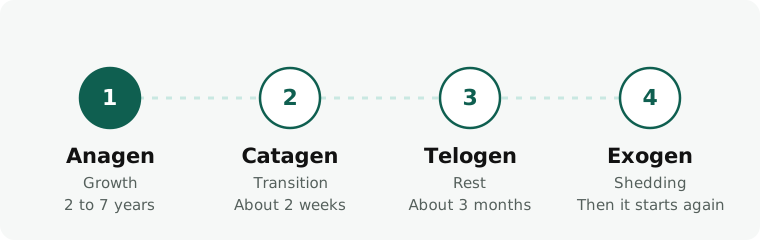
Losing 50 to 100 hairs a day is normal, and you will notice more on the days you wash or brush.1 The hairs that come out were already in the resting phase and would have shed anyway. Thinning becomes visible when that balance shifts: when more follicles drop into rest at once, when the growth phase gets shorter, or when follicles gradually shrink and produce finer hair.
Why hair thins: the most common causes
Thinning rarely has a single cause. Many people have two or more of the ones below.
1. Genetics and hormones (pattern hair loss)
Pattern hair loss, known medically as androgenetic alopecia, is the most common cause of thinning in both men and women.23 In people who are genetically susceptible, the hormone dihydrotestosterone (DHT), made from testosterone by an enzyme called 5-alpha-reductase, gradually shortens the growth phase. Over many cycles, affected follicles shrink and produce shorter, finer hairs, a process called miniaturization.2
In men, it usually shows as a receding hairline or thinning at the crown. In women, it more often appears as a widening part and diffuse thinning over the top of the head, with the front hairline intact.3
2. Hormonal shifts in women
The drop in estrogen around perimenopause and menopause can make the effects of androgens on the follicle more noticeable.3 Many women also experience heavy shedding two to four months after giving birth, which typically settles on its own.4 Thyroid conditions and polycystic ovary syndrome (PCOS) are other common hormonal contributors, and both are worth ruling out with a doctor.
3. Stress, illness and major life events
A significant shock to the body, such as a high fever, surgery, severe illness, major emotional stress or a sudden change in diet, can push a large number of follicles into the resting phase at the same time. This is called telogen effluvium. Because the resting phase lasts around three months, the shedding usually starts two to three months after the event, which is why people often don’t connect the two.4
Telogen effluvium is usually temporary, and hair tends to recover within about six months once the trigger has passed.4 Research in mice has also shown how the stress hormone corticosterone can keep hair follicle stem cells in an extended resting state, which may be one reason long-term stress affects hair.10
4. Nutrition
Hair follicles are some of the most active cells in the body, so they are sensitive to shortfalls. Low iron, low vitamin D, low zinc, too little protein and rapid weight loss have all been linked to shedding.5 If you are not deficient, there is little evidence that extra supplements help, and too much vitamin A or selenium can cause hair loss.5 A blood test will show whether you are low in anything.
5. Styling habits and tension
Tight ponytails, braids, buns, extensions and weaves pull on the follicle over and over. Over time this can cause traction alopecia, usually along the hairline and temples. Caught early, it is reversible. If the tension continues for years, the damage can become permanent.11
6. Scalp health
Researchers have linked oxidative stress, inflammation and long-running scalp problems such as flaking to poorer hair quality and more shedding.12 Keeping the scalp clean and free of buildup makes sense as part of regular hair care.
7. Age
As we get older, the growth phase naturally shortens and individual hairs tend to become finer, so some reduction in volume is a normal part of ageing for everyone.2
Warning signs that deserve a doctor’s visit
Gradual thinning is rarely urgent. Some patterns should still be checked by your family doctor or a dermatologist. In Canada, your family doctor can order blood work and refer you to a dermatologist if needed. Book an appointment if you notice:
- Sudden, heavy shedding or hair coming out in clumps
- Round or patchy bald spots
- Itching, burning, pain, redness or scaling on the scalp
- Shiny or scarred-looking skin where hair used to be
- Loss of eyebrows, eyelashes or body hair
- Thinning along with fatigue, weight changes or irregular periods
- Shedding that started after a new medication, or that lasts longer than six months
Preventing hair loss: what helps
Genes set your risk of pattern hair loss, and there is a lot you can do around them. For temporary shedding, dealing with the trigger usually lets hair recover. For pattern hair loss, starting early tends to keep more hair, because it is easier to keep existing follicles active than to revive ones that have already shrunk.6
Start with the cause
The most useful step in preventing hair loss is a diagnosis. A doctor can check for iron deficiency, thyroid problems and hormonal conditions, and tell pattern hair loss apart from temporary shedding.
Know the treatments with the strongest evidence
For pattern hair loss, European evidence-based guidelines recommend topical minoxidil for both men and women, and oral finasteride for men.6 In Canada, minoxidil is sold without a prescription, while finasteride requires one. Both work best when started early and must be used continuously to maintain results. Your doctor or pharmacist can explain the benefits and side effects for your situation.
Eat for your hair
A balanced diet with enough protein, iron-rich foods and a variety of fruit and vegetables supports healthy hair growth. If you suspect a deficiency, get tested before taking supplements.5
Go easy on styling
Loosen tight hairstyles, change your part and ponytail position regularly, give extensions a break, and limit high heat and harsh chemical treatments.11
Manage stress and sleep
Major stress can trigger shedding months later, so sleep, exercise and managing stress count as hair care too.410
Look after your scalp
Keep your scalp clean and comfortable, and take a few minutes to massage it. In one small study, nine men who had a four-minute standardized scalp massage every day for 24 weeks showed an increase in hair thickness, although the number of hairs did not change.13
Botanicals for hair: what the research says
Plant extracts have a long history in hair care, and researchers have studied several of them in human trials, animal studies and lab tests. Below is what they found for the botanicals people ask us about most. All of them are in our Hair Therapy formulas.
| Botanical | What was studied | What they found |
|---|---|---|
| Rosemary | Rosemary oil on the scalp, in men with pattern hair loss | Hair counts rose significantly over six months |
| Saw palmetto | Oral supplements and topical products | Improvement reported in several human trials |
| Ginseng | Red ginseng extract on cultured human hair follicles and in mice | Increased follicle cell activity and faster hair growth in mice |
| Amla | Fruit extract on human follicle cells | Increased growth of dermal papilla cells |
| Hibiscus | Leaf and flower extracts of a related species, Hibiscus rosa-sinensis | Promoted hair growth in animal and lab tests |
| Cedarwood | An essential oil blend, in alopecia areata | 44% improved, compared with 15% using carrier oils |
| Argan oil | Antioxidant and fatty acid content | Rich in vitamin E, and valued for conditioning, softness and shine |
 Rosemary
Research: a six-month human trial, plus lab and mouse research
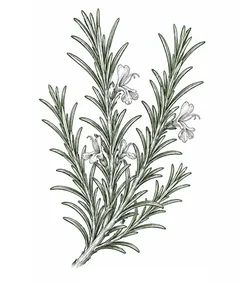
In 2015, researchers randomly assigned 100 men with pattern hair loss to apply either rosemary oil or 2% minoxidil to the scalp twice a day for six months. Hair counts rose significantly in both groups at six months, with no significant difference between them.7 In mice, rosemary leaf extract has also been shown to block 5-alpha-reductase and promote regrowth.14 Our full guide to rosemary oil for hair covers the research in detail.
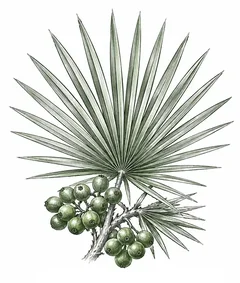 Saw palmetto
Research: human trials, mostly with oral supplements
Saw palmetto, from the berries of the Serenoa repens palm, is known for inhibiting 5-alpha-reductase, the same enzyme that finasteride targets. In a two-year study of 100 men with pattern hair loss, 38% of those taking 320 mg of saw palmetto daily improved, and 68% of those taking finasteride improved.8 An earlier trial of an oral saw palmetto and beta-sitosterol combination reported improvement in most participants.15 A 2020 systematic review found positive results across several studies of oral and topical products.16
G Ginseng
Research: cultured human hair follicles and mice
In a 2015 study, red ginseng extract and its active compounds, called ginsenosides, increased the activity of cultured human hair follicle cells and counteracted some of the effects of DHT in the lab. The extract also sped up hair growth in mice.9
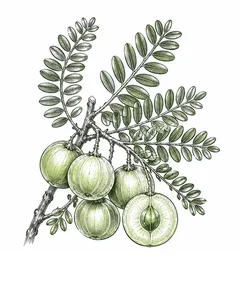 Amla
Amla
Research: human follicle cells in the lab
Amla, or Indian gooseberry (Phyllanthus emblica), has a long history in Ayurvedic hair care and is rich in antioxidants. In the lab, amla fruit extract increased the growth of dermal papilla cells, the cells at the base of the follicle that help regulate the hair cycle.17
H Hibiscus
Research: animal and lab studies on a related species
Leaf and flower extracts of Hibiscus rosa-sinensis promoted hair growth in animal and lab testing.18 HUSSSH uses bark extract from a different species, Hibiscus syriacus, which was not part of that research.
C Cedarwood
Research: a human trial of a four-oil blend
In a 1998 trial, people with alopecia areata, an autoimmune form of hair loss, massaged a blend of thyme, rosemary, lavender and cedarwood essential oils into their scalp every night for seven months. 44% of that group improved, compared with 15% of those using carrier oils alone.19 Cedarwood was one of the four oils, and the study used Atlas cedarwood. HUSSSH contains Himalayan cedarwood (Cedrus deodara).
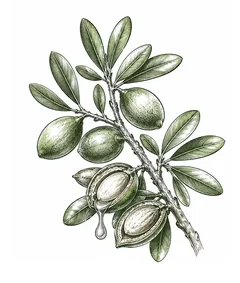 Argan oil
Research: antioxidant and conditioning research
Argan oil is rich in vitamin E and fatty acids, and research has focused on its antioxidant and nourishing properties.20 In hair care it is valued for conditioning, softness and shine.
A scalp-first daily routine
Whatever the cause of your thinning, these habits are worth building.
- Cleanse regularly and gently. Washing does not cause hair loss. If your scalp feels tight or dry, a milder sulphate-free cleanser may feel more comfortable.
- Massage while you wash. Use your fingertips, not your nails, and take a few minutes over it.13
- Condition the lengths. Conditioner reduces breakage from brushing and styling, which helps hair look fuller.
- Style with less tension and heat. Rotate hairstyles and let your hair air-dry when you can.11
- Support it from the inside. Eat well, sleep well, and get blood work if you suspect a deficiency.5
- Give it time. Hair grows about a centimetre a month, so any change takes months to show.
Frequently asked questions about preventing hair loss
It depends on the cause. Good nutrition, gentle styling, stress management and scalp care can reduce avoidable shedding, and temporary shedding usually recovers once the trigger is resolved. Genetic pattern hair loss is slowed most reliably by approved medical treatments. Botanicals such as rosemary and saw palmetto have been studied in human trials of pattern hair loss.678
Yes. Most people shed 50 to 100 hairs a day, and washing loosens hairs that were already in the resting phase, so you will see more on wash days.1 If you are suddenly finding much more than usual, or it is coming out in clumps, see a doctor.
Yes. Significant physical or emotional stress can trigger telogen effluvium, a wave of shedding that usually begins two to three months later and typically recovers within about six months.4
One randomized trial in 100 men found that rosemary oil applied twice daily for six months increased hair count about as much as 2% minoxidil.7 Our guide to rosemary oil for hair covers the research in more detail.
No. The hairs that come out while washing were already at the end of their cycle and would have shed within days anyway.4 Washing less often only means they come out all at once on the day you do.
See your family doctor or a dermatologist if your hair loss is sudden, patchy, painful or itchy, comes with other symptoms, or has lasted more than six months. See the warning signs above for the full list.
References
- American Academy of Dermatology Association. Do you have hair loss or hair shedding? aad.org ↩
- Lolli F, Pallotti F, Rossi A, et al. Androgenetic alopecia: a review. Endocrine. 2017;57(1):9-17. PubMed ↩
- Fabbrocini G, Cantelli M, Masarà A, et al. Female pattern hair loss: a clinical, pathophysiologic, and therapeutic review. Int J Womens Dermatol. 2018;4(4):203-211. PubMed ↩
- Malkud S. Telogen effluvium: a review. J Clin Diagn Res. 2015;9(9):WE01-WE03. PubMed ↩
- Almohanna HM, Ahmed AA, Tsatalis JP, Tosti A. The role of vitamins and minerals in hair loss: a review. Dermatol Ther (Heidelb). 2019;9(1):51-70. PubMed ↩
- Kanti V, Messenger A, Dobos G, et al. Evidence-based (S3) guideline for the treatment of androgenetic alopecia in women and in men, short version. J Eur Acad Dermatol Venereol. 2018;32(1):11-22. PubMed ↩
- Panahi Y, Taghizadeh M, Marzony ET, Sahebkar A. Rosemary oil vs minoxidil 2% for the treatment of androgenetic alopecia: a randomized comparative trial. Skinmed. 2015;13(1):15-21. PubMed ↩
- Rossi A, Mari E, Scarno M, et al. Comparitive effectiveness of finasteride vs Serenoa repens in male androgenetic alopecia: a two-year study. Int J Immunopathol Pharmacol. 2012;25(4):1167-1173. doi:10.1177/039463201202500435 ↩
- Park GH, Park KY, Cho HI, et al. Red ginseng extract promotes the hair growth in cultured human hair follicles. J Med Food. 2015;18(3):354-362. doi:10.1089/jmf.2013.3031 ↩
- Choi S, Zhang B, Ma S, et al. Corticosterone inhibits GAS6 to govern hair follicle stem-cell quiescence. Nature. 2021;592(7854):428-432. PubMed ↩
- Billero V, Miteva M. Traction alopecia: the root of the problem. Clin Cosmet Investig Dermatol. 2018;11:149-159. PubMed ↩
- Trüeb RM. The impact of oxidative stress on hair. Int J Cosmet Sci. 2015;37(Suppl 2):25-30. PubMed ↩
- Koyama T, Kobayashi K, Hama T, Murakami K, Ogawa R. Standardized scalp massage results in increased hair thickness by inducing stretching forces to dermal papilla cells in the subcutaneous tissue. Eplasty. 2016;16:e8. PubMed ↩
- Murata K, Noguchi K, Kondo M, et al. Promotion of hair growth by Rosmarinus officinalis leaf extract. Phytother Res. 2013;27(2):212-217. PubMed ↩
- Prager N, Bickett K, French N, Marcovici G. A randomized, double-blind, placebo-controlled trial to determine the effectiveness of botanically derived inhibitors of 5-alpha-reductase in the treatment of androgenetic alopecia. J Altern Complement Med. 2002;8(2):143-152. PubMed ↩
- Evron E, Juhasz M, Babadjouni A, Mesinkovska NA. Natural hair supplement: friend or foe? Saw palmetto, a systematic review in alopecia. Skin Appendage Disord. 2020;6(6):329-337. doi:10.1159/000509905 ↩
- Luanpitpong S, Nimmannit U, Pongrakhananon V, Chanvorachote P. Emblica (Phyllanthus emblica Linn.) fruit extract promotes proliferation in dermal papilla cells of human hair follicle. Res J Med Plant. 2011;5(1):95-100. doi:10.3923/rjmp.2011.95.100 ↩
- Adhirajan N, Ravi Kumar T, Shanmugasundaram N, Babu M. In vivo and in vitro evaluation of hair growth potential of Hibiscus rosa-sinensis Linn. J Ethnopharmacol. 2003;88(2-3):235-239. PubMed ↩
- Hay IC, Jamieson M, Ormerod AD. Randomized trial of aromatherapy: successful treatment for alopecia areata. Arch Dermatol. 1998;134(11):1349-1352. PubMed ↩
- Monfalouti HE, Guillaume D, Denhez C, Charrouf Z. Therapeutic potential of argan oil: a review. J Pharm Pharmacol. 2010;62(12):1669-1675. PubMed ↩
This article is for general information only and is not medical advice. Talk to your doctor or a dermatologist about any hair loss. HUSSSH® Hair Therapy products are cosmetics. They are not intended to diagnose, treat, cure or prevent any disease, including hair loss. The studies referenced above used specific extracts, concentrations and methods that differ from rinse-off hair care products.
 Proudly Canadian owned and operated. Buy Canadian!